
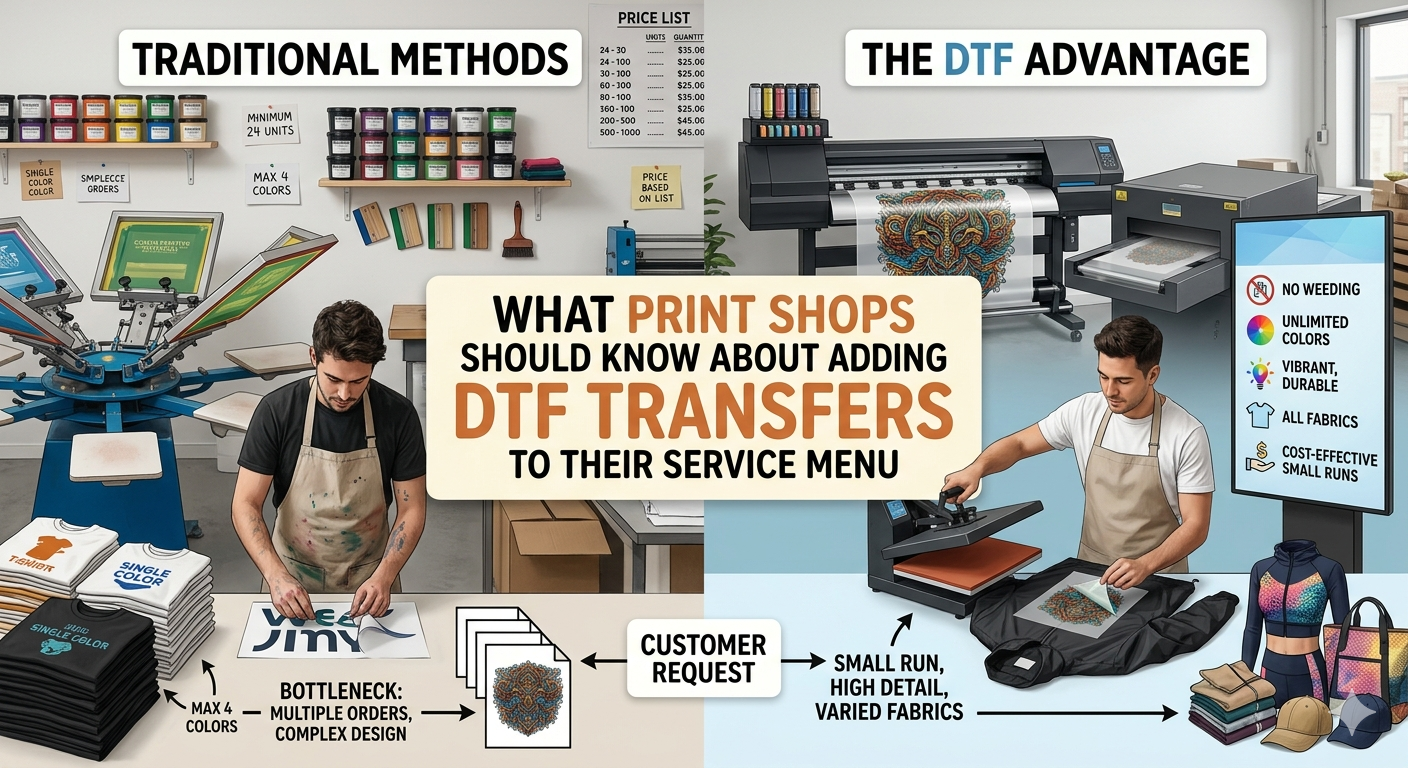
Customer demand for small-run apparel decoration is outpacing what screen printers can cost-effectively deliver at the bottom of the quantity range. DTF transfers have become the standard answer for orders under 50 pieces, and shops that aren’t offering them are sending that volume somewhere else. Here’s what you need to evaluate the decision clearly.
The DTF Equipment Landscape
In-housing DTF production requires three pieces of equipment: a DTF printer, a powder shaker and curer, and a heat press.
The heat press you likely already have. The printer and the shaker/curer are the investment.
Entry-level DTF printers — adequate for light commercial use and proofing — start around $2,000-$5,000. At this level, you’re looking at slower print speeds and narrower roll widths (typically 13 inches), which works for single-piece and small-batch production but limits throughput for high-volume runs.
Production-grade DTF printers capable of meaningful shop volume run $10,000-$30,000 or more depending on print width and throughput capacity. These machines support 24-inch or wider rolls, faster print heads, and continuous operation with automated powder application.
The powder shaker and curer are sometimes sold as a combined unit with the printer and sometimes purchased separately. Budget $1,500-$5,000 for this depending on automation level. Manual powder application works at low volume but becomes a bottleneck at scale.
The barrier to entry for commercial DTF production has dropped significantly in the past three years. A shop can get into DTF at a meaningful quality level for under $10,000 all-in, which is materially lower than comparable-quality screen printing equipment.
What Customers Are Ordering
The DTF sweet spot is orders of 1-48 pieces with full-color artwork, particularly on dark garments where screen printing requires a costly underbase color.
The customer profile is specific: small businesses ordering staff shirts in quantities of 12-24, sports leagues needing team shirts below the minimums most screen shops will quote, school organizations putting together event shirts the week of an event. These customers used to hear "our minimum is 24 pieces" and go to Printful. DTF brings them back to local shops.
Restaurant groups are a consistently strong segment — new location openings, staff uniform updates, seasonal menu launches. They need shirts fast, in small quantities, and they repeat the order pattern multiple times per year. Restaurants are also comfortable spending on quality blanks, which improves your margin per unit.
Outsourcing vs. In-Housing DTF Production
Not every shop needs to invest in equipment immediately. The outsourced model — ordering ready-to-press transfers from a DTF supplier, pressing in-house on existing equipment — lets you offer the service and test customer demand before committing capital.
custom shirts Richardson TX have built their entire workflow around this model, supplying ready-to-press transfers for decorators who want to offer the service without the equipment investment. You order the transfer, press it on the blank, and handle the customer relationship and markup. Your existing heat press handles the fulfillment.
The margin in the outsourced model is thinner per unit than in-house production, but the capital risk is zero. Once you’ve established a customer base and volume that justifies the equipment purchase, you transition to in-house. Many shops run the outsourced model indefinitely and find the margin acceptable given the capital they’re not tying up.
How to Price DTF for Profit
In the outsourced model, your input cost is the transfer price plus the blank. Mark the transfer at 2-2.5x cost, source blanks at wholesale and mark at 1.5-2x, and charge for pressing labor. A finished custom shirt on a quality blank (Bella + Canvas or similar) retailing at $25-$35 typically carries healthy margin even in the outsourced model at small quantities.
In-house production drops your input cost substantially at volume, improving margin in the 30-50% range depending on throughput. At that point, pricing becomes a competitive strategy question rather than a survival question.
DTF is a complementary addition to existing screen print services, not a replacement. It fills the orders below your screen print minimum that you were previously turning away. Add it to your menu and stop referring that business to someone else.