
A startup founder and enterprise director both contacted me last week, each frustrated with their agencies. The startup paying ₹25,000 monthly complained their agency treated them like an afterthought,minimal attention, generic strategies, and service quality that didn’t match their needs. The enterprise spending ₹5 lakhs monthly felt overwhelmed by elaborate strategies and complexity their team couldn’t absorb. Both had the same problem: agencies applying one-size-fits-all approaches when different business scales demand fundamentally different strategies.
This mismatch happens constantly. Small businesses get minimum viable service from agencies prioritizing bigger accounts. Large businesses get drowned in sophistication they don’t need. Understanding what actually makes sense for your business size prevents these expensive mismatches.
The Business Size Reality
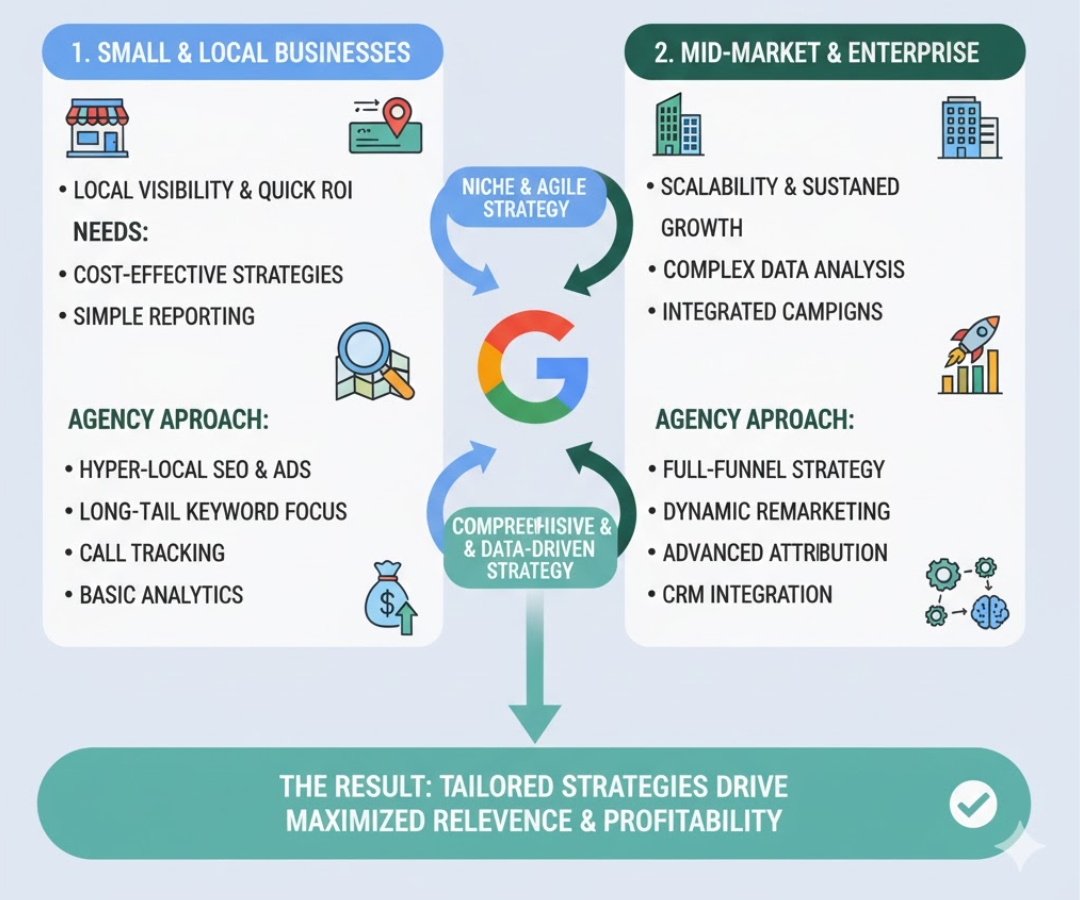
Here’s what most businesses don’t understand about agency partnerships: the strategies, service models, and expectations should vary dramatically based on business scale, not just apply identical approaches to every client. A local service business with ₹50,000 monthly budget requires completely different management than a national ecommerce company spending ₹3 lakhs. The tactics, time investment, complexity level, and service structure must match business realities.
Small local businesses benefit most from focused, simple strategies targeting narrow geographic areas with high-intent keywords. They need agencies understanding local market dynamics—how “near me” searches behave, which location extensions drive foot traffic, how Local Services Ads work for eligible industries, and what Google Business Profile optimization delivers. Overcomplicating campaigns with sophisticated audience layering, elaborate remarketing funnels, and multi-channel coordination wastes small budgets that perform better through concentrated simplicity.
Medium-sized businesses operating regionally or nationally can leverage more sophistication—Performance Max campaigns, strategic audience targeting, remarketing programs, and multi-channel coordination. They have budgets supporting the testing and optimization that compound advantages over time. Their agencies should provide full-service management including landing page optimization, conversion tracking refinement, and strategic expansion into adjacent opportunities.
Enterprise businesses require dedicated teams, sophisticated attribution modeling, comprehensive multi-channel strategies, and integration with complex martech stacks. They need agencies coordinating with internal teams, aligning advertising with broader marketing initiatives, and providing strategic consultation extending beyond just campaign management. The service model must accommodate committee decision-making, procurement processes, and organizational complexity that small businesses don’t face.
The Local Business Reality That Demands Specialized Approaches
This is where understanding what a google ad marketing agency should deliver for local businesses becomes critical. The strategies that work for local service companies differ fundamentally from national ecommerce or B2B SaaS approaches.
Geographic targeting precision determines success for local businesses. Setting radius targeting around service areas—10km for restaurants, 30km for home services, 50km for specialized retail—ensures ads reach only people who can actually become customers. The targeting setting must specify “Presence: People in or regularly in your included locations” rather than “Presence or Interest” which wastes money showing ads to people merely interested in your location but physically elsewhere. This single setting mistake drains 20-30% of local business budgets.
Location extensions showing business address, phone number, and distance prominently in ads drive both calls and store visits. Research shows 42% of local searchers click map pack results. Connecting Google Business Profile to Google Ads pulls business information automatically, improving ad relevance and enabling location-specific features. Local campaigns promoting physical locations across Search, Maps, Display, and YouTube increase both online conversions and foot traffic when configured properly.
Local Services Ads for eligible industries—plumbers, electricians, locksmiths, HVAC contractors—provide pay-per-lead pricing where you only pay when customers actually contact you. This model eliminates wasted clicks from browsers never intending to hire anyone. The Google Guarantee badge builds immediate credibility local service providers struggle establishing through traditional ads. Eligibility requires background checks and licensing verification creating competitive barriers.
“Near me” search optimization capturing high-intent local queries requires specific keyword strategies. Terms like “emergency plumber near me” or “best pizza delivery near me” show purchase intent far exceeding generic searches. Ad copy emphasizing local presence—”Serving [City] Since 2010″ or “Same-Day Service Throughout [Region]”,resonates more than generic messaging ignoring geography. Landing pages featuring local phone numbers, service area maps, and regional testimonials convert better than generic corporate pages.
Call tracking and local actions conversions measure results beyond just website form submissions. Many local businesses generate 60-80% of leads through phone calls. Without call tracking, campaigns optimize toward website conversions representing minority of actual business. Local actions tracking store visits and in-store purchases completes attribution picture for businesses driving foot traffic through advertising.
Seasonal patterns affect local businesses intensely—HVAC peaks in summer and winter, landscaping in spring through fall, tax services January through April. Strategic budget allocation concentrating spending during high-demand periods while scaling back off-season prevents wasting money when nobody’s buying. Seasonality adjustments inform Smart Bidding of expected conversion rate changes during promotional periods or seasonal events.
The Growth Business Complexity That Changes Everything
Working with a comprehensive best google ads agency enables strategies matching business sophistication levels. As companies grow from local to regional to national scale, campaign complexity must evolve accordingly.
Multi-location businesses require campaign structures enabling performance comparison across geographies. Separate campaigns for major markets reveal which locations deliver strongest returns, informing budget allocation decisions. Location-specific ad copy highlighting regional presence—”Now Serving Chicago” versus generic national messaging—improves relevance. Landing pages customized for each market with local phone numbers, addresses, and testimonials convert better than generic corporate pages.
Performance Max campaigns reaching across Search, Shopping, Display, YouTube, Gmail, and Discovery maximize reach for businesses ready to scale. The comprehensive channel coverage finds customers wherever they engage across Google’s ecosystem. Asset requirements—multiple headlines, descriptions, images, and videos in various formats—demand more sophisticated creative development than simple text ads. But properly configured Performance Max delivers 13% more conversions at similar costs versus channel-specific approaches.
Strategic audience targeting becomes worthwhile at scale. In-market audiences showing active purchase intent, remarketing lists reconnecting with website visitors, customer match targeting existing customers, and lookalike audiences finding similar prospects all concentrate spending on highest-value segments. Small budgets can’t support this sophistication—segmentation requires sufficient volume in each audience for algorithms to optimize effectively.
Multi-channel coordination creates synergies when budgets support comprehensive strategies. Awareness campaigns on YouTube building brand recognition, Search campaigns capturing intent, Shopping ads showcasing products, and remarketing converting browsers who didn’t buy initially—these coordinated efforts deliver 25-40% better results than isolated single-channel tactics. But this sophistication only makes sense when total marketing budgets exceed ₹2-3 lakhs monthly.
Advanced attribution modeling revealing how different touchpoints contribute to conversions informs smarter budget allocation. Data-driven attribution distributing credit based on actual contribution patterns rather than simplistic last-click assumptions shows which channels deserve more investment. This insight guides strategic decisions about where to scale spending for maximum impact. But attribution analysis requires conversion volume—at least 300 conversions monthly—making it impractical for smaller businesses.
Integration with broader Google Ads automation and coordination across platforms like Facebook advertising enables sophisticated customer journey optimization at enterprise scale.
The Seasonal Strategy That Matches Business Cycles
Campaign strategies must adapt to seasonal demand patterns affecting every business differently. Understanding your specific seasonal cycle and adjusting campaigns accordingly prevents wasting money during slow periods while missing opportunities during peaks.
Identifying seasonal trends through historical data analysis reveals when demand concentrates. Retailers peak Q4 during holiday shopping. Travel businesses spike summer months. Tax services concentrate January through April. HVAC companies see dual peaks,air conditioning demand in summer, heating in winter. Landscaping runs spring through fall. Each industry has unique patterns requiring customized approaches.
Budget allocation should flex dramatically with seasonal demand rather than maintaining constant spending year-round. Doubling or tripling budgets during peak periods captures elevated demand when conversion rates are highest. Scaling back 50-70% during slow seasons preserves budget for high-return periods. This strategic reallocation often improves overall ROI 30-50% versus static budgeting.
Seasonal keyword strategies targeting event-specific searches maximize relevance. “Christmas gifts for dad” peaks mid-November through December. “Back to school laptops” concentrates August. “Valentine’s Day flowers” spikes early February. Adding seasonal terms 4-6 weeks before peak periods gives algorithms time to learn before demand surges. Removing seasonal keywords after peaks prevents wasting money on irrelevant off-season searches.
Ad copy adaptation emphasizing seasonal urgency improves click-through and conversion rates. “Limited Christmas Collection—Order by Dec 15 for Delivery” creates time-sensitive motivation generic messaging can’t match. “Summer Sale Ends Sunday” drives immediate action. Seasonal context in headlines and descriptions boosts relevance scores reducing costs.
Bid adjustments during competitive seasonal periods prevent losing visibility as rivals increase spending. CPCs often spike 40-80% during high-demand seasons as competition intensifies. Raising bids proactively maintains impression share rather than reacting after visibility drops. Strategic bidding focuses on high-converting time periods,weekend evenings for gift purchases, weekday mornings for B2B services.
Seasonality adjustments inform Smart Bidding of expected conversion rate changes during promotional events or seasonal spikes. Flash sales, limited-time promotions, or predictable seasonal surges can be flagged 1-7 days in advance so algorithms adjust bidding appropriately. This advanced feature works best for short-duration events with historical conversion data proving significant rate changes occur.
The Service Model That Matches Business Needs
The agency service structure should align with business size and sophistication. Small local businesses need simplified reporting focused on calls and foot traffic, not elaborate multi-page presentations analyzing dozens of metrics they don’t understand. They need monthly check-ins, not weekly strategy sessions consuming their limited bandwidth. They need straightforward recommendations, not complex testing frameworks requiring internal resources to implement.
Growth companies benefit from more sophisticated service including regular strategic reviews, comprehensive testing programs, landing page optimization, conversion rate improvement initiatives, and proactive expansion recommendations. They have capacity absorbing this sophistication and budgets justifying the investment in continuous optimization.
Enterprise businesses require dedicated account teams, integration with internal marketing operations, alignment with broader brand strategies, and collaboration with multiple stakeholders. The service model must accommodate organizational complexity, approval processes, and coordination that smaller businesses don’t need.
Understanding which service level matches your business prevents paying for sophistication you can’t use or receiving inadequate attention because your scale doesn’t interest agencies focused on bigger accounts. The right match delivers appropriate strategies, suitable reporting complexity, and service intensity matching your actual needs rather than forcing you into ill-fitting standard packages.
The Match That Maximizes Value
Campaign success requires agency partnerships matching business size with appropriate strategies, service models, and expectations. Local businesses need focused geographic targeting and simplified approaches. Growth companies benefit from sophisticated multi-channel strategies and continuous optimization. Enterprises require dedicated teams and complex integration with organizational realities.
Smart businesses recognize that cookie-cutter approaches applying identical strategies regardless of business size waste money through mismatched complexity or inadequate service. They seek agencies understanding their specific scale and customizing accordingly—simple when simplicity works better, sophisticated when complexity delivers incremental value.
The alternative is getting drowned in elaborate strategies you can’t execute or receiving minimum viable service when your business deserves comprehensive attention. The right match transforms agency partnerships from frustrating relationships into growth engines delivering results matching your business’s actual needs and capacity.
Disclaimer: This article is for general information only. It shares ideas and examples to help you understand Google Ads and marketing. It is not official advice from Google or any other company. Results may be different for every business. Always check Google’s official guidelines and talk to a certified professional before making big marketing decisions.