

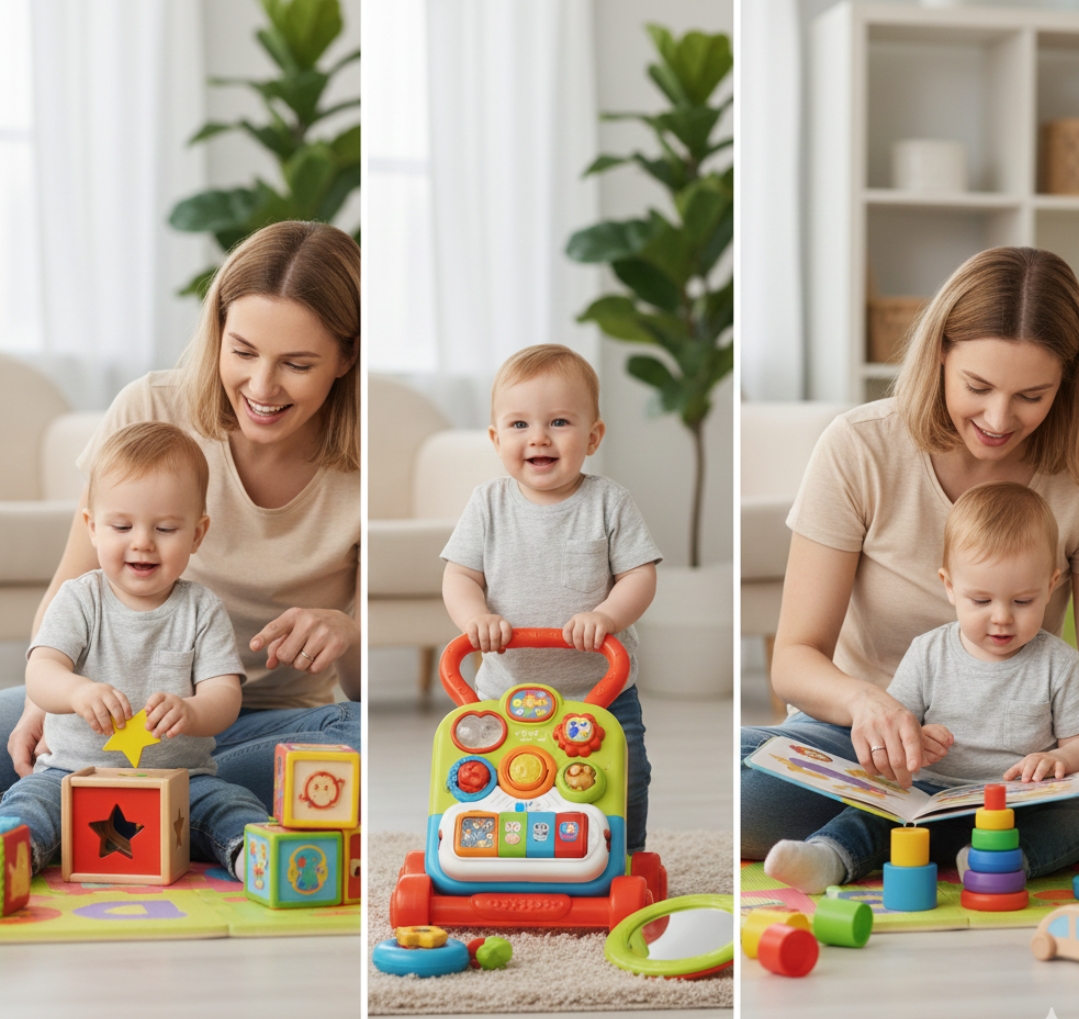
One-year-olds learn through play in ways that look deceptively simple but actually involve complex skill building. Picking the right toys for 1 year old children means understanding how play connects to developmental progress. The toy that entertains for five minutes before being abandoned probably isn’t supporting growth as effectively as the simple toy that gets used repeatedly in different ways. At this age, kids need toys that respond to their actions, can be explored through multiple senses, and remain engaging as their capabilities evolve week by week.
Cause-and-Effect Toys
Activity cubes or busy boards pack multiple cause-and-effect features into compact designs. Buttons that make sounds, dials that spin, doors that open, and levers that move teach kids that their actions produce results. This understanding forms the foundation for more complex problem-solving later. Look for toys with varied mechanisms rather than repetitive actions.
Musical toys that respond to touch reinforce the connection between action and outcome. Simple drums, keyboards, or instruments that produce distinct sounds when manipulated help kids understand they control the environment. The immediate auditory feedback maintains interest and encourages repeated exploration.
Pop-up toys where pressing buttons makes characters appear combine fine motor practice with surprise and delight. Figuring out how to make something happen, then making it happen again, teaches persistence and planning. The unpredictability of which character appears where adds cognitive challenge.
Building Fine Motor Control
Large pegboards with chunky pegs develop pincer grip and hand-eye coordination. The action of grasping a peg, aiming for the hole, and pushing it in requires multiple skills working together. As control improves, kids can place pegs in patterns or specific locations, adding cognitive challenge to physical practice.
Simple puzzles with large, knobbed pieces teach problem-solving while building hand control. Wooden puzzles with 3 to 6 pieces work well for this age. Knobs make the pieces easier to grasp, and the limited options make success achievable without overwhelming frustration.
Threading toys with large beads and thick laces introduce early sequencing concepts. One-year-olds might just push beads onto a lace rather than creating patterns, but that physical action develops the fine motor control needed for more complex manipulation later.
Exploration and Discovery Toys
Containers with lids provide endless exploration opportunities. Simple boxes, baskets, or jars with easy-open lids let kids practice opening, closing, filling, and dumping. These actions might seem basic, but they teach spatial relationships, cause-and-effect, and problem-solving. The fact that almost anything can become container contents keeps the play fresh.
Toys that transform or change appearance fascinate developing minds. Simple pop-up toys, collapsible tunnels, or toys with hidden features encourage investigation and discovery. The element of surprise maintains engagement while teaching object permanence and spatial reasoning.
Sensory balls with different textures, weights, and sizes support tactile exploration and gross motor play. Soft, bumpy, or ridged surfaces provide varied sensory input. Different sizes require different grasping strategies, building hand strength and control.
Language and Communication Support
Simple toy phones or pretend communication devices encourage imitative play and vocalization. One-year-olds copy adult behavior intensely, and pretending to talk on a phone prompts language practice. Even if the “words” are babbles, the turn-taking and intonation patterns support communication development.
Toy sets representing familiar objects help build vocabulary. Play food, toy vehicles, or miniature household items give concrete representations of things kids encounter daily. Naming these objects during play reinforces word-object connections and builds receptive language.
Picture cards or simple flashcards work when used interactively rather than as rote memorization tools. Talking about the images, making associated sounds, or incorporating them into games makes learning natural and engaging.
Movement-Based Learning
Push toys that require walking support the transition to independent mobility. Unlike walkers that kids sit in, push toys require kids to balance and coordinate their own movements. The feedback of pushing something that moves encourages walking practice while building confidence.
Balls of various sizes teach different motor skills. Large balls kids can sit on or roll against develop core strength. Medium balls can be thrown and kicked, building coordination. Small balls require more precise grasping and releasing, developing fine motor control.
Ride-on toys with steering mechanisms add cognitive challenge to physical play. Figuring out how to make the toy go where they want requires planning and spatial awareness alongside physical coordination.
Problem-Solving and Cognitive Development
Simple mechanical toys with visible mechanisms teach cause-and-effect relationships. Wind-up toys, toys with gears, or marble runs with transparent parts let kids see how their actions create results. Understanding these connections forms the basis for logical thinking and scientific reasoning.
Matching games with just a few pairs develop memory and visual discrimination. At one year old, kids might just enjoy looking at the pictures, but they’re building the skills needed for actual matching. Starting simple prevents frustration while establishing game-playing concepts.
Sorting toys that separate by color, shape, or size introduce categorization concepts. While one-year-olds might not sort accurately yet, the exposure to categories and the physical practice of moving objects builds foundational math and logic skills.
Toys That Grow With Kids
Open-ended toys provide value across developmental stages. Blocks start as objects to grasp and bang together, progress to simple stacking, then become construction materials for increasingly complex creations. This adaptability makes them worth the investment.
Art supplies designed for young kids support creativity across age ranges. Large crayons work for early scribbling, then for attempting shapes and letters later. The same materials stay relevant as skills develop.
Pretend play items like play kitchens, tool benches, or baby dolls start with simple imitative actions, then support increasingly complex imaginative scenarios as cognitive abilities mature.
Safety and Selection Criteria
Size matters significantly at this age. Toys and their parts should be larger than a toilet paper tube to prevent choking hazards. The physical robustness of toys matters too because one-year-olds test durability limits constantly.
Material quality affects both safety and longevity. BPA-free plastics, untreated wood, and non-toxic paints ensure toys don’t introduce harmful chemicals. Solid construction without small parts that can detach prevents both choking hazards and broken toys.
Noise levels deserve consideration. Excessively loud toys can damage hearing and create annoying environments. If a toy seems too loud in the store, it’ll be worse in a home setting.
Toy preferences vary dramatically between individual kids. What fascinates one child might bore another. Observing the child’s current interests provides better selection guidance than generic age recommendations.