

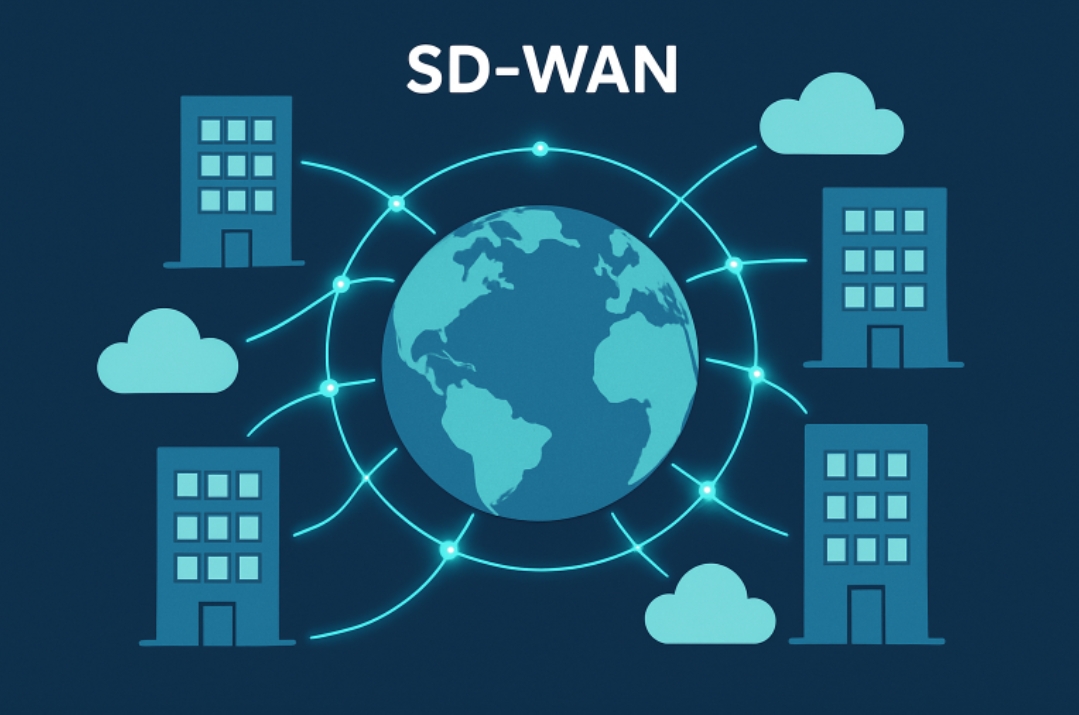
Introduction to SD-WAN
Enterprises today operate in a complex digital environment, balancing demands for efficiency, scalability, and robust security across geographically dispersed sites. Software-Defined Wide Area Networking (SD-WAN) has emerged as a transformative solution, allowing organizations to manage network traffic intelligently and securely while optimizing both resources and performance. This paradigm shift is crucial for businesses needing to adapt quickly to digital transformation strategies, support remote workforces, and reduce operational overhead.
One notable advantage of SD-WAN is its ability to manage networks centrally by decoupling the data and control planes and abstracting the hardware layer. This enables organizations to collaborate with leading SD-WAN enterprise providers for a tailored, strategic approach to network management and security, ensuring optimized application delivery across any connectivity type.
SD-WAN integrates seamlessly with existing infrastructures, eliminating many traditional WAN limitations. Rather than relying on slow, inflexible MPLS networks, SD-WAN supports a mix of broadband, LTE, and legacy WAN links—reducing complexity and opening new opportunities for cost savings and agility. As cyber threats increase and cloud-based applications become more prevalent, organizations require not just connectivity but also a secure, adaptable framework that scales with their growth plans and compliance needs.
By leveraging SD-WAN, businesses are better positioned to meet these challenges head-on.
Key Features of SD-WAN
- Dynamic Path Selection: SD-WAN continuously assesses multiple network links and automatically selects the most reliable, lowest-latency route for each application or user flow. This results in higher network uptime and consistently superior performance, even as conditions fluctuate.
- Centralized Management: Comprehensive management portals provide real-time visibility, unified policy enforcement, and streamlined troubleshooting across the entire network. IT teams can provision new branches or adjust configurations remotely, accelerating deployment and reducing management costs.
- Integrated Security: Most SD-WAN solutions feature deep security capabilities such as application-aware firewalls, encrypted tunnels, intrusion prevention systems (IPS), and secure web gateways, making it easier to enforce security at every site and minimize attack surfaces.
- Cloud Optimization: With direct-to-cloud routing and prioritized cloud application traffic, SD-WAN bypasses legacy data center bottlenecks. This delivers faster, more reliable access to critical SaaS platforms, improving productivity and user experience for both on-site and remote workers.
Advantages of Implementing SD-WAN
Enhanced Network Performance
SD-WAN optimizes application performance by directing traffic over the most appropriate connection—whether MPLS, broadband, or wireless—using real-time analytics and automated decisions. This minimizes packet loss and latency, making it especially beneficial for bandwidth-sensitive, real-time applications like video conferencing and ERP systems.
Cost Efficiency
Traditional WAN models, reliant on private MPLS links, are costly and slow to scale. SD-WAN leverages cost-effective, commodity Internet connections to supplement or even replace MPLS, slashing bandwidth expenses without compromising performance. Centralized orchestration further lowers TCO by enabling IT teams to manage more sites with fewer resources.
Improved Security Posture
Security is foundational to SD-WAN design. With integrated tools for data encryption, segmentation, and next-generation firewalls, organizations can more easily enforce zero-trust principles, ensuring sensitive data stays protected. The ability to manage security policies centrally ensures rapid response to threats and compliance with regulatory frameworks.
Scalability and Flexibility
As businesses expand, SD-WAN makes it straightforward to connect new offices, remote sites, and cloud resources with minimal configuration time. Its modular design is crucial for organizations that frequently adapt network topology due to mergers, acquisitions, or fluctuating workforce demands.
Real-World Applications and Case Studies
Organizations in retail, healthcare, finance, and manufacturing have rapidly adopted SD-WAN to streamline network operations and accelerate digital initiatives. A leading global retailer, for example, leveraged SD-WAN to connect hundreds of branch locations, reporting improved access to cloud-based inventory systems and a dramatic cut in circuit costs. In another case, a healthcare provider utilized SD-WAN to support secure, HIPAA-compliant telemedicine—enabling reliable video consultations and seamless health data exchange across sites, significantly enhancing patient care and provider collaboration.
Financial services firms benefit from SD-WAN’s rapid failover and performance guarantees, especially for regulatory compliance and client transaction integrity. Similarly, manufacturers use SD-WAN to enable industrial IoT deployments, remote monitoring, and real-time analytics, while reducing network complexity and downtime.
Conclusion
SD-WAN is driving the next wave of enterprise network transformation, enabling businesses to overcome traditional WAN limitations and fully leverage the digital economy. With dynamic routing, centralized management, integrated security, and seamless cloud integration, SD-WAN is a strategic investment for companies seeking resilient, cost-effective, and future-ready networking solutions. In a landscape marked by disruption and innovation, SD-WAN equips enterprises with the agility and confidence to thrive. For enterprises considering SD-WAN adoption, partnering with experienced providers and leveraging comprehensive research will ensure a robust, scalable migration that meets both current needs and future growth.