

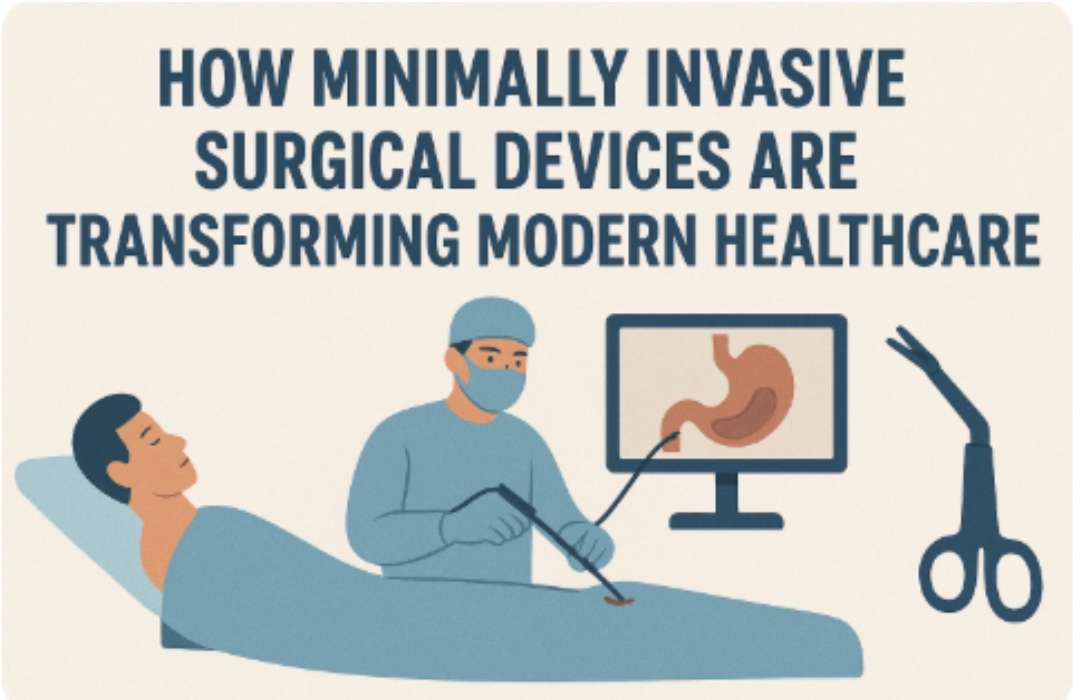
Surgery has come a long way; what used to be the domain of large incisions and lengthy hospital stays is increasingly being accomplished through the use of small trocars, with less pain, faster recovery, and reduced risk.
Leading the way are minimally invasive surgical devices, tools designed for precision, flexibility, and endurance in the most delicate of procedures.
But their impact extends far beyond the surgeon’s hand. They’re redefining patient encounters, hospital budgets, and the art of medicine.
As companies trend toward miniaturization, the use of better materials and tighter tolerances introduces manufacturing challenges, regulatory acceptability issues, and performance testing problems. Coatings, materials selection, and microfabrication become mission-critical.
This article outlines the primary ways these devices are transforming healthcare today, making it safer, enabling new procedures, reducing costs, and expanding the possibilities in surgery.

1. Healing in Half the Time with Less Trauma
Minimally invasive surgical devices enable physicians to make small incisions or openings in the body, allowing them to operate through these openings rather than large cuts.
This translates to less destruction of the surrounding tissues, minimal bleeding, and fewer complications such as infection.
Patients recover more quickly, experience less postoperative pain, and are generally discharged from the hospital earlier.
Laparoscopic or endoscopic surgery, for example, utilizes slender tubes, a telescope, and specialized instruments—all of which must be fabricated with fantastically high accuracy and coated to be inserted inside the body.
Trauma reduction, besides enhancing patient satisfaction, allows the potential for operating on such patients who stand a poor chance of survival from major surgery.
2. Enhanced Safety through Enhanced Materials and Coatings
The smaller the device becomes and the more intricate it is, the greater the requirements for materials and surface technology become.
Sophisticated electroplating and coating technologies provide biocompatibility, corrosion resistance, electrical conductivity, and wear resistance.
Thin metal films on guidewires or catheters, for example, provide stable signal transmission and radiopacity, allowing devices to be visualized when imaging is performed after administration.
Such coatings must meet demanding regulatory and performance expectations; thus, surface engineering is an underpinning of high-performance, trustworthy devices.
In essence, wear-resistant coatings become an invisible but vital barrier layer that prevents device failure in the body.
3. Facilitating New Procedures and Blending Techniques
Almost all procedures are today (or have become) safer due to advances in minimally invasive technology.
For example, difficult cardiovascular procedures, such as ablations or robot-assisted procedures, would be essentially impossible—or at the very least, extremely challenging—without devices that can follow tortuous anatomic tracts.
High-precision, ultra-miniature devices underlie hybrid imaging, robotics, and device-delivery treatments.
New technologies are opening up previously reserved areas for open surgery. Previously, traditionally defined high-risk patient populations could be addressed with decreased invasiveness, thereby increasing the scope of surgical interventions.
4. Cost-Effectiveness, Scalability, and Hospital Economics
The initial cost of developing minimally invasive technology is prohibitive, but it is paid back several times over in the long run.
Shorter hospital lengths of stay create bed capacity, fewer complications save money down the line, and faster recovery allows patients to return to their normal lives earlier.
Resilience also sustains replacement or maintenance rates at low levels. These savings compound for health systems and hospitals.
At the manufacturing level, good manufacturing and great coatings reduce defects, waste, and rework levels.
That improves margins and yields. So, both medical professionals and device makers benefit from better, more consistent equipment.
5. Better Precision, Imaging, and Real-Time Feedback
Emerging minimally invasive devices are more often designed with sensors, imaging modalities, and feedback mechanisms.
Think micro-cameras, pressure sensors, or electrodes as integrated iterative tools. Such requirements include conductivity, stable interfaces, and shielding—all of which can be achieved through the use of advanced materials and engineering.
Visualization and online monitoring during the procedure enable the surgeon to navigate, avoid damage, and position accurately. This accuracy enhances outcomes through providing the operator with more information and control over subtle movements.
Without assured materials and coatings, these sensor integrations would be non-uniform or compromised.
6. Regulatory and Quality Standards Compliance
With these devices coming into contact with tissue, body fluids, and possible implants, control by the controller is stringent.
Biocompatibility, traceability, reliability, and sterilization requirements must be fulfilled. Manufacturing processes—specifically surface treatment and coating—must be able to support stringent quality demands.
Audit, batch control, and reproducibility requirement puts material and coating technology solidly in a validated, documented, and stringently well-placed position.
In reality, the success of a minimally invasive device is as dependent on repeatable manufacturing and regulatory confidence as it is on ground breaking design.
7. Facilitating Innovation and Tailored Interventions
And finally, minimally invasive surgical devices are innovation enablers. Because they can be so thin, componentized, and electronics-enabled, they enable research in new treatments, such as implantable sensors, smart stents, image-guided drug delivery, and robot microrobotic arms, to name a few.
The anatomic flexibility and responsiveness of such devices enable targeted interventions to the anatomy or to the patient’s needs.
Iterating in design and testing becomes rapidly possible as technology advances, for example, through micro-machining, additive manufacturing, and novel coating chemistries. It is a snowball effect in the long run: optimizing devices results in more indications, which require even better devices.
Final Thoughts
Minimally invasive medical technology is revolutionizing the future of surgery—beyond the paradigm from brute force to elegance, weighty to quick recovery, and hazard to precision.
Far less reliant on genius design, it rests on unseen engineering of material, coatings, and microfabrication.
They make it safer, enable new clinical opportunities, reduce cost, enable regulatory confidence, and drive the next generation of medical advances.
As the medical community requires smarter, safer, and less invasive solutions, the use of these devices will continue to expand.
To all who care about design, production, control, and clinical application, adopting innovation, collaboration, and engineering is the key to the future of medicine.
Disclaimer: This article is for general information only. It is not medical advice. Always talk to a doctor or healthcare professional for medical questions or treatment. We do not recommend any specific product or procedure. We try to give accurate information, but we cannot guarantee it. Use the information at your own risk.